

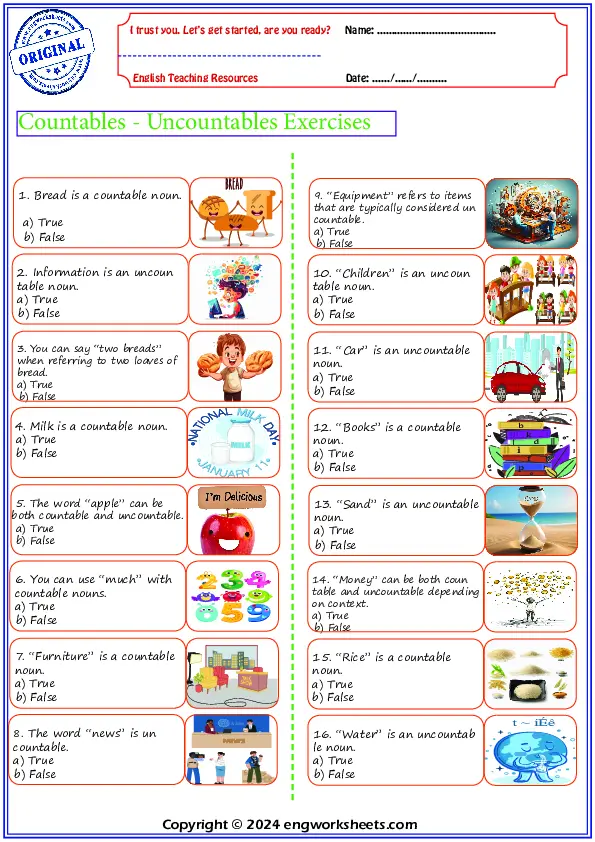
Countables - Uncontables Exercises, Free Printable Countables - Uncontables ESL Worksheets

A Countables-Uncontables English worksheet is a tool used to help English language learners understand the difference between countable and uncountable nouns. Countable nouns are objects or concepts that can be counted, such as "books" or "apples." Uncountable nouns, on the other hand, are things that cannot be counted, such as "water" or "information."

The worksheet typically includes a list of nouns and requires the student to identify whether they are countable or uncountable. The student may also be asked to use the correct article (a/an or the) or quantifier (some, any, much, many) with each noun.

This type of worksheet is beneficial for English language learners because it helps them to understand the grammar rules surrounding countable and uncountable nouns, which can be challenging for non-native speakers. By practicing with a worksheet, learners can become more comfortable with using these types of nouns in context.

The worksheet may also include exercises that require the student to use countable and uncountable nouns in sentences. This helps the student to understand how these types of nouns are used in everyday language.

Overall, a Countables-Uncontables English worksheet is a valuable tool for English language learners who are looking to improve their understanding and use of countable and uncountable nouns. With practice and repetition, learners can become more confident in their ability to use these nouns correctly in both written and spoken English.

9 items found.

Countables - Uncontables Printable Worksheets

Countables - Uncountables Free Printable English ESL Worksheet Worksheet Preview

Countables - Uncountables Free Printable English ESL Worksheet

Countable and uncountable nouns are important in English grammar. Countable nouns, like "apple" and "book," can be counted and have both singular and plural forms. Uncountable nouns, like "water" and "information," refer to substances or concepts that cannot be counted and do not have a plural form. Exercises on countable and uncountable nouns help improve the ability to distinguish between these two types of nouns. Engworksheets.com offers many worksheets and exercises for those who want to study these topics. These resources are suitable for classroom use or individual study and are effective in improving grammar skills. Countable and uncountable nouns exercises

Level: Intermadiate Age: 9-11
Free printable ESL Countables and Uncountables Exercises Worksheet Preview

Free printable ESL Countables and Uncountables Exercises

Countable and uncountable nouns are important in English grammar. Countable nouns, like "apple" and "book," can be counted and have both singular and plural forms. Uncountable nouns, like "water" and "information," refer to substances or concepts that cannot be counted and do not have a plural form. Exercises on countable and uncountable nouns help improve the ability to distinguish between these two types of nouns. Engworksheets.com offers many worksheets and exercises for those who want to study these topics. These resources are suitable for classroom use or individual study and are effective in improving grammar skills. Countable and uncountable nouns exercises Countable nouns list Uncountable nouns list Examples of countable and uncountable nouns Worksheets for countable and uncountable nouns Countable vs. uncountable nouns exercises Countable and uncountable nouns grammar rules

Level: Intermadiate Age: 9-11
Free Printable Countables - Uncountables English ESL Worksheets Worksheet Preview

Free Printable Countables - Uncountables English ESL Worksheets

Introduction to Uncountable Nouns: A Simple Guide Uncountable nouns, or mass nouns, refer to things that cannot be counted individually. Unlike countable nouns, uncountable nouns do not have a plural form and are used with singular verbs. Examples include substances like "water," concepts like "happiness," and categories like "furniture." Key Points About Uncountable Nouns No Plurals: Uncountable nouns stay singular (e.g., "information" not "informations"). Quantifiers: Use phrases like "some," "a little," and "much" to describe quantity (e.g., "a little sugar"). Avoid Articles: Do not use "a" or "an" with uncountable nouns (e.g., "some advice," not "an advice"). For more resources and worksheets to practice uncountable nouns, visit engworksheets.com. Conclusion Understanding uncountable nouns is essential for mastering English grammar. Explore more tips and exercises on engworksheets.com to improve your skills. Keywords: uncountable nouns, uncountable noun examples, uncountable nouns in English, English grammar, using uncountable nouns, common uncountable nouns, grammar tips, uncountable noun mistakes.

Level: Elementary Age: 9-11
Countable and Uncountable Nouns Worksheet with Answers - PDF Worksheet Preview

Countable and Uncountable Nouns Worksheet with Answers - PDF

Master countable and uncountable nouns with this printable A1-A2 English grammar worksheet for ESL and EFL learners. “Make It Count!” includes 32 questions across four focused activities: classifying nouns, choosing a, an, some or any, completing questions with much or many, and selecting correct singular, plural and verb forms. Clear examples, colourful visuals and a practical speaking task make learning engaging and easy to follow. The complete answer key and teacher notes provide explanations for every item. Ideal for primary English classes, beginner lessons, tutoring, homework, revision and independent practice, this countable and uncountable nouns worksheet PDF helps students use quantifiers, articles and everyday food vocabulary accurately and confidently.

Level: Elementary Age: 9–12 (Uppe
Countable and Uncountable Nouns Worksheet PDF with Answers Worksheet Preview

Countable and Uncountable Nouns Worksheet PDF with Answers

Explore countable and uncountable nouns with Count It. Use It., an original printable English worksheet from EngWorksheets. Designed for A1–A2 ESL learners, this two-page PDF includes 32 exercises covering noun classification, a and an, some and any, how much and how many, and common grammar mistakes. Clear illustrations and everyday situations make grammar practice engaging. Learners complete gap-fill exercises, correct sentences and practise speaking through a day-out planning activity. A separate answer key includes short explanations and helpful teacher notes. With readable Comic Sans MS text and a white, toner-friendly background, this ESL grammar worksheet is ideal for classroom lessons, private tutoring, homework and independent study.

Level: Elementary Age: 9–12 (Uppe